
Shopping Cart
- Tu Aloe Canario
- Canarian Aloe Vera
- 0 likes
- 342 views
- 0 comments
Our aloe cosmetics guide
A cream seems like one thing when you spread it. Inside, its structure can be far more interesting. We explain what an emulsion is and what it really tells you about a cosmetic.

When you choose a cream, you probably think about how your skin feels before how its ingredients are arranged. That's a good starting point: a cosmetic also has to suit you and the moment you use it. But one word helps you understand the jar in your hands: emulsion.
Today we take a calm look at it. We'd like you to be able to look at our products more knowledgeably, without turning every purchase into a chemistry lesson.
It's all about tiny droplets
Water and oil don't mix spontaneously and stay mixed. An emulsion disperses one of those liquids as droplets within the other. They're still two phases: one is dispersed and the other surrounds it. So although a cream looks uniform, its structure has more than one part.
Emulsifiers help maintain that structure by working where the phases meet. A formula brings together ingredients with different functions; having aloe vera in a cream's name doesn't on its own describe how it's built.
Water outside or oil outside
In an oil-in-water emulsion, oil droplets are surrounded by a water phase. In a water-in-oil emulsion, water droplets sit inside an oil phase. These are abbreviated O/W and W/O.
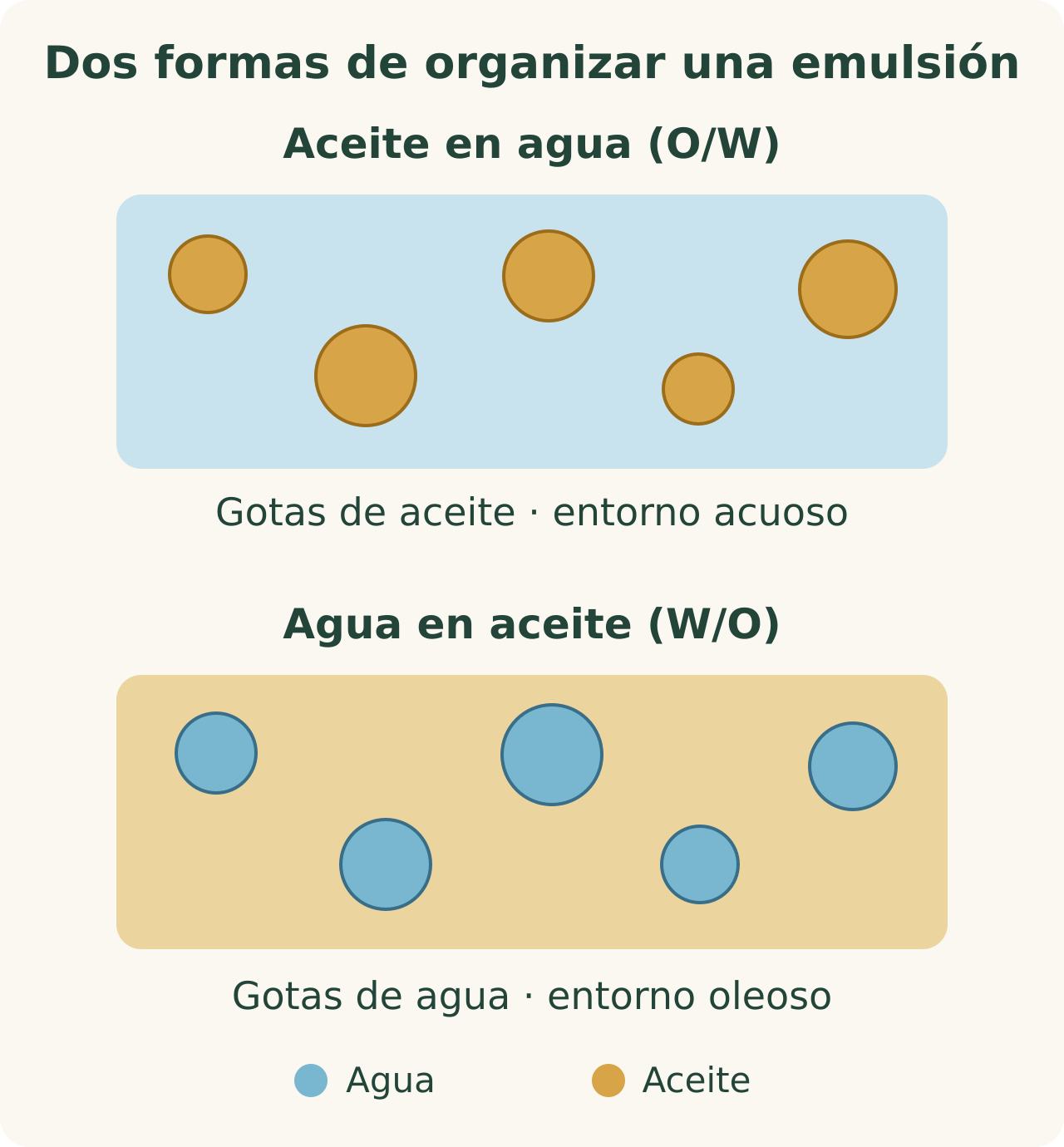
The useful thing about the drawing is noticing what surrounds what. We don't use it to pick a winning formula or to work out how much aloe a jar contains. Those are different questions that need different information.
What we can say about our aloe and chamomile cream
If you want a familiar example while reading, see our 250 ml green-lid aloe and chamomile cream. On its product page we explain its cosmetic use and stated features. The photo below shows the pack as it appears in our shop.

To tell you whether this cream is O/W or W/O we need technical confirmation from the manufacturer. With the information available, we leave that open. We'd rather explain the concept properly and keep it separate from what we can confirm about a specific product.
Texture tells you about your experience
When you try a cream, you can notice whether it spreads comfortably, whether you prefer that feel for day or night, or whether you'd like to use a little less next time – always following its instructions. These are useful details for choosing.
In our guide, we keep claims about composition for documented facts. Describing a cream as light or rich helps us talk about how it feels; it's not enough to give it a technical label. If you need help choosing between our products, tell us what texture you're looking for and which area you want to care for.
The formula comes ready-made
You might be tempted to add a little water to lighten a cream or mix it with oil in the jar. Spain's medicines agency (AEMPS) advises against adding substances to cosmetics or making mixtures the manufacturer hasn't indicated. We follow that approach: use it as it comes and as directed on the label.
It's also best to keep the container closed and protected from excessive heat and sun. If its colour, smell or consistency changes, AEMPS recommends throwing it away. Don't try to restore the texture by stirring or adding ingredients.
A common question
Do emulsifier and preservative mean the same thing?
No. They're different functions: the emulsifier helps organise the phases; preservation protects the product against microbiological spoilage. If you're interested in the second, we cover it in our guide to preservatives in aloe vera cosmetics.
Learn more
To bring this into everyday care, we explain how we approach a routine with our aloe and chamomile cream. And if you'd like to learn about more ingredients, read about the role of glycerin in an aloe vera cream.
Our practical takeaway: understanding a word on the pack should help you choose with peace of mind. When something isn't confirmed, we'll tell you; when we can explain it simply, we'll be here.

Comments (0)