
Shopping Cart
- Tu Aloe Canario
- Canarian Aloe Vera
- 0 likes
- 306 views
- 0 comments
As evening falls, an aloe on a terrace seems unchanged: the leaves stay still, the rosette keeps its shape and nothing signals a change. Inside, however, another part of its day may be starting. To understand how this plant lives, it's worth looking beyond what we see at first glance.
Today we look at aloe vera through that small everyday scene. We'll follow two clues that work together: a water store in the leaves, and a way of organising carbon uptake between night and day.
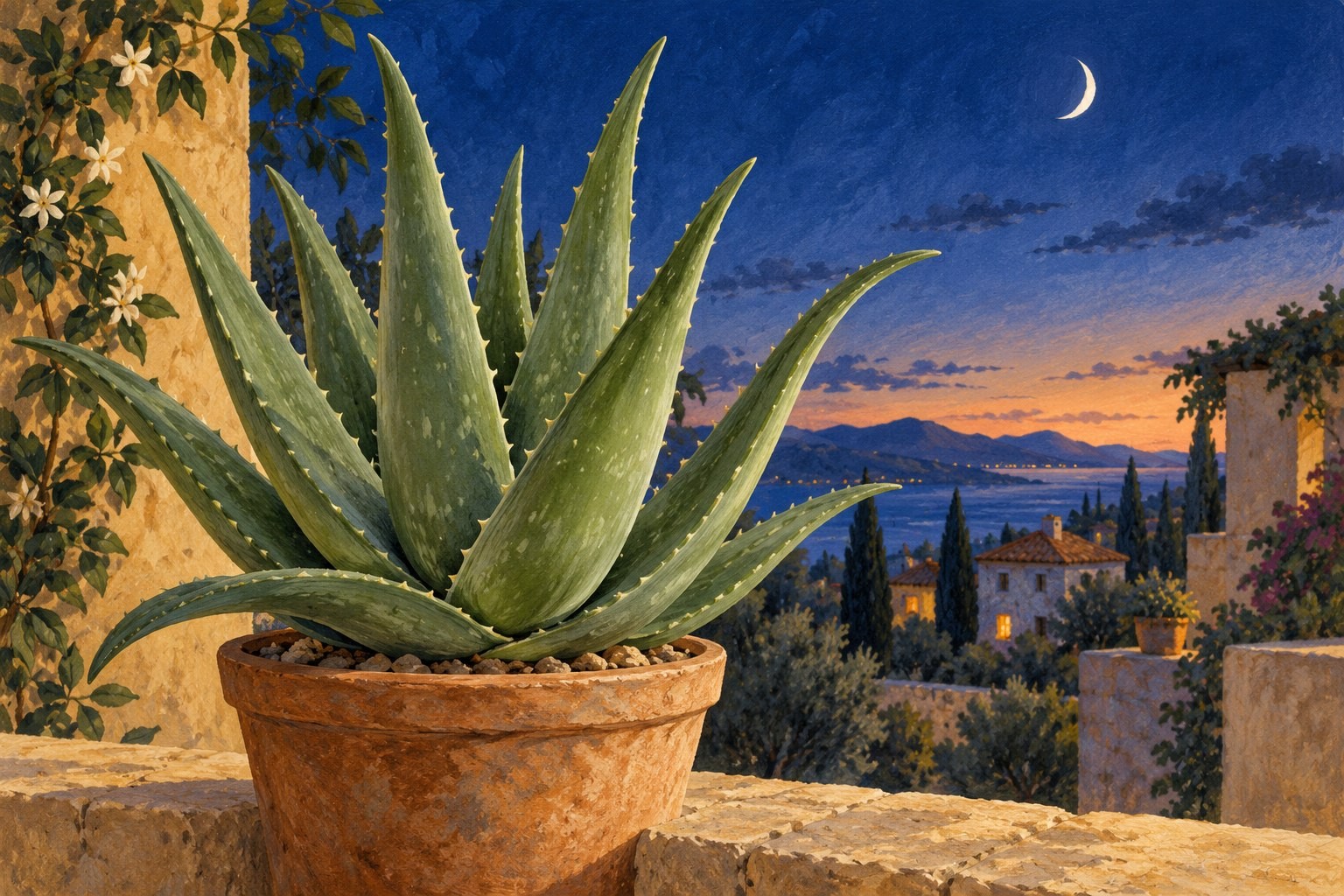
Editorial illustration of an aloe at dusk. The scene is imaginary.
The fleshy leaves have a job
Aloe's thickness isn't just decorative. Its leaves contain tissue specialised in storing water, as the Royal Botanic Gardens, Kew explains. This reserve is part of what we call succulence and helps the plant get through dry periods.
Think of it as a pantry that fills up and gets used. The comparison helps explain the function, although there's no hollow tank inside the leaf: the water is held in living tissue. So a fleshy leaf tells you something about how the plant lives, but it doesn't let you estimate by eye how many days it can go without water.
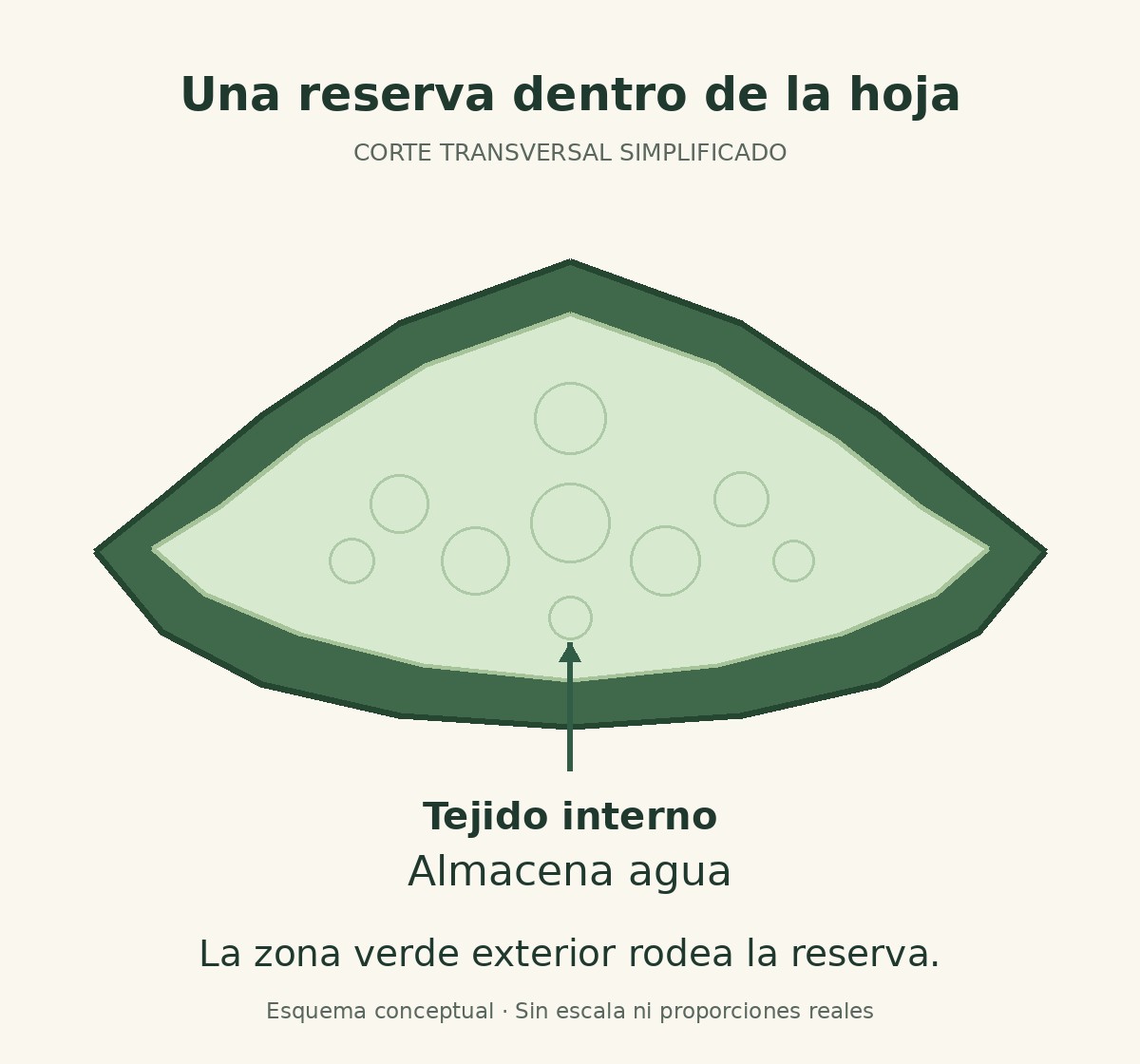
Original diagram of the water store. Anatomy is simplified and proportions are not to scale.
When it cools down, gas exchange changes
To make sugars through photosynthesis, plants need carbon from the carbon dioxide in the air (CO₂). They exchange it through tiny pores called stomata. Opening them also lets water escape as vapour.
Aloe vera uses crassulacean acid metabolism, known as CAM. In its typical pattern it can take in CO₂ at night, store that carbon temporarily and use it when there is light. By keeping its stomata closed for much of the day, it reduces the water loss linked to that exchange.
Night doesn't replace light
It's worth pausing here: taking in carbon at night doesn't mean doing all the work in the dark. Light is still needed for photosynthesis. The point of CAM is to separate some of those tasks in time. Nor does it work like a switch with a fixed time; gas exchange varies with the plant's condition and surroundings.
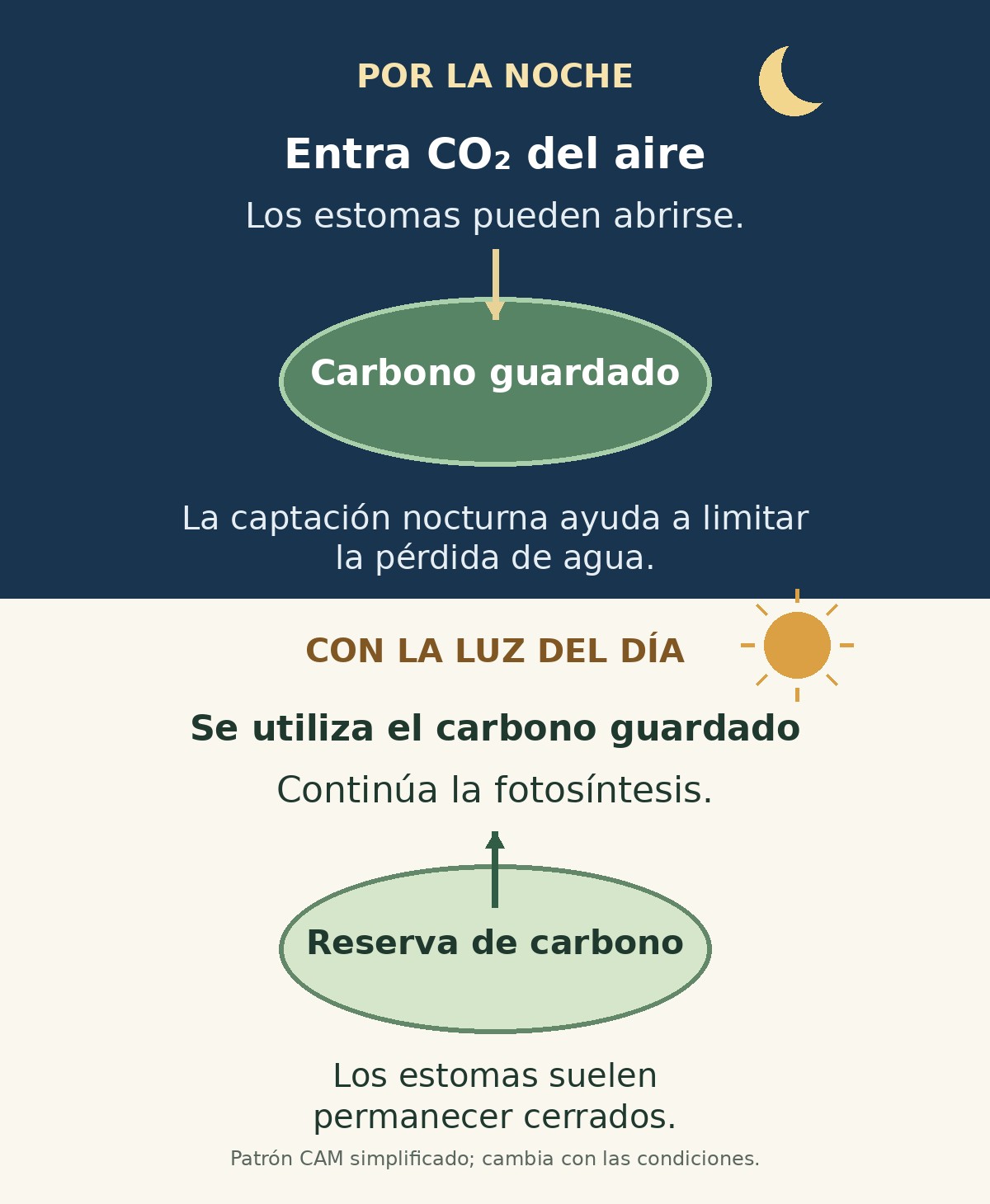
Original diagram of the CAM pattern. A simplified explanation, not a measurement of a specific plant.
Surviving drought comes at a cost
It's tempting to think: if it stores water and saves it, the less we water it, the better. That conclusion doesn't hold. In a 2022 study in the Atacama Desert, Delatorre-Castillo and colleagues observed that aloes survived prolonged drought but also recorded losses in leaf thickness and photosynthetic capacity.
Our practical takeaway is simple: staying alive and growing well are different things. That experiment helps explain aloe's resilience; it doesn't provide a watering schedule for a terrace, nor does it invite you to recreate its conditions at home.
What this means for your pot
Rather than testing its endurance, look at the whole picture: light, compost, drainage and how active the plant is. The RHS recommends a free-draining compost and adjusting watering between growth and rest. To apply this at home, we've gathered the steps in our guide to caring for potted aloe vera.
When it comes to Canarian aloe vera, knowing these adaptations helps us understand the plant grown on the islands. On their own, they don't prove a different species or an advantage exclusive to one origin. For us, knowing aloe starts with explaining clearly what it does and observing the plant in front of us.
Learn more
Continue with our guide to aloe vera flowering. Water storage and the CAM rhythm explain one part of its life; the flowers let you observe another without cutting a leaf.
Sources for further reading
Royal Botanic Gardens, Kew · Aloe vera
Water-storage tissue and botanical description.
Cambridge University Botanic Garden · Plant rhythms
Institutional explanation of the CAM pattern; the page uses a cactus as its example.
Cockburn · Plant Physiology, 1979
Research on gas exchange and stomatal resistance in CAM plants, including Aloe vera. Abstract consulted.
Winter and Holtum · Plant Physiology, 2002
Study of daytime and night-time CO₂ uptake, with Aloe vera among the species. Repository abstract consulted.
Delatorre-Castillo et al. · Plants, 2022
Research on prolonged drought in Aloe vera. Abstract and figure captions consulted; not a guide for home growing.
RHS · Aloe vera profile
Growing and drainage guidance; seasonal references are for the British context.
Sources reviewed on 30 October 2026.

Comments (0)