
Shopping Cart
One pack costs less at the till; another contains more product. Which suits your purchase better? At Tu Aloe Canario we suggest a simple calculation: express the price for the same amount of product.
The price per 100 ml lets you compare volumes without confusing the size of the jar with how much it contains. After doing the maths, we still need to consider the formula, the intended use and how much we'll actually use. The figure guides only part of the choice.
The calculation to bring prices to the same quantity
To work out a price per 100 ml, divide the pack price by the millilitres it contains and multiply by 100. Use the final selling price and the stated nominal contents, not how big the container looks. Spanish rules on price indication aim to make comparison easier through prices per unit of measure. Here we use 100 ml as a teaching base, without replacing the legal unit that applies to each pack. [1]
A made-up example you can repeat
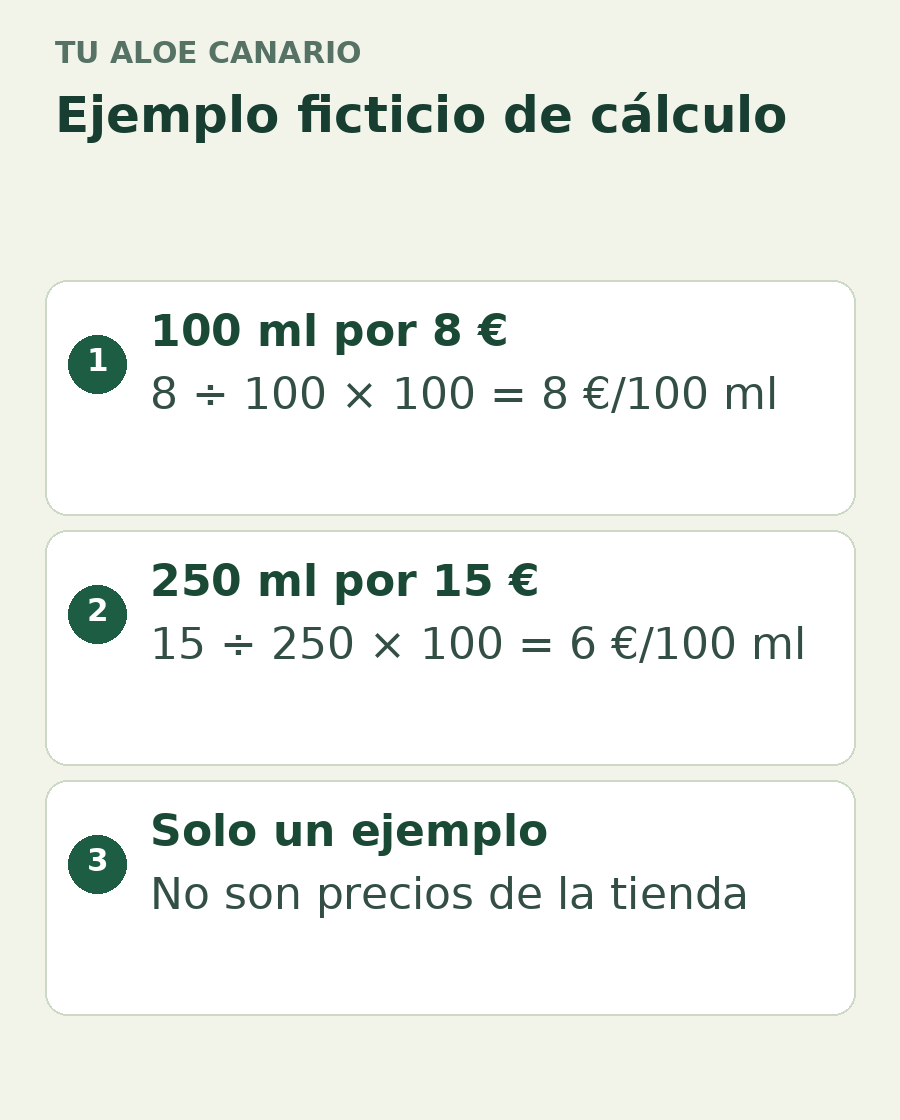
Imagine two packs of the same formula: the first contains 100 ml and costs €8; the second contains 250 ml and costs €15. These amounts are invented purely to explain the calculation: they are not prices or offers in our shop.
The first works out at €8 per 100 ml. For the second, 15 divided by 250 and multiplied by 100 gives €6 per 100 ml. The second costs less for that quantity, although you pay more up front.
Which products make sense to compare
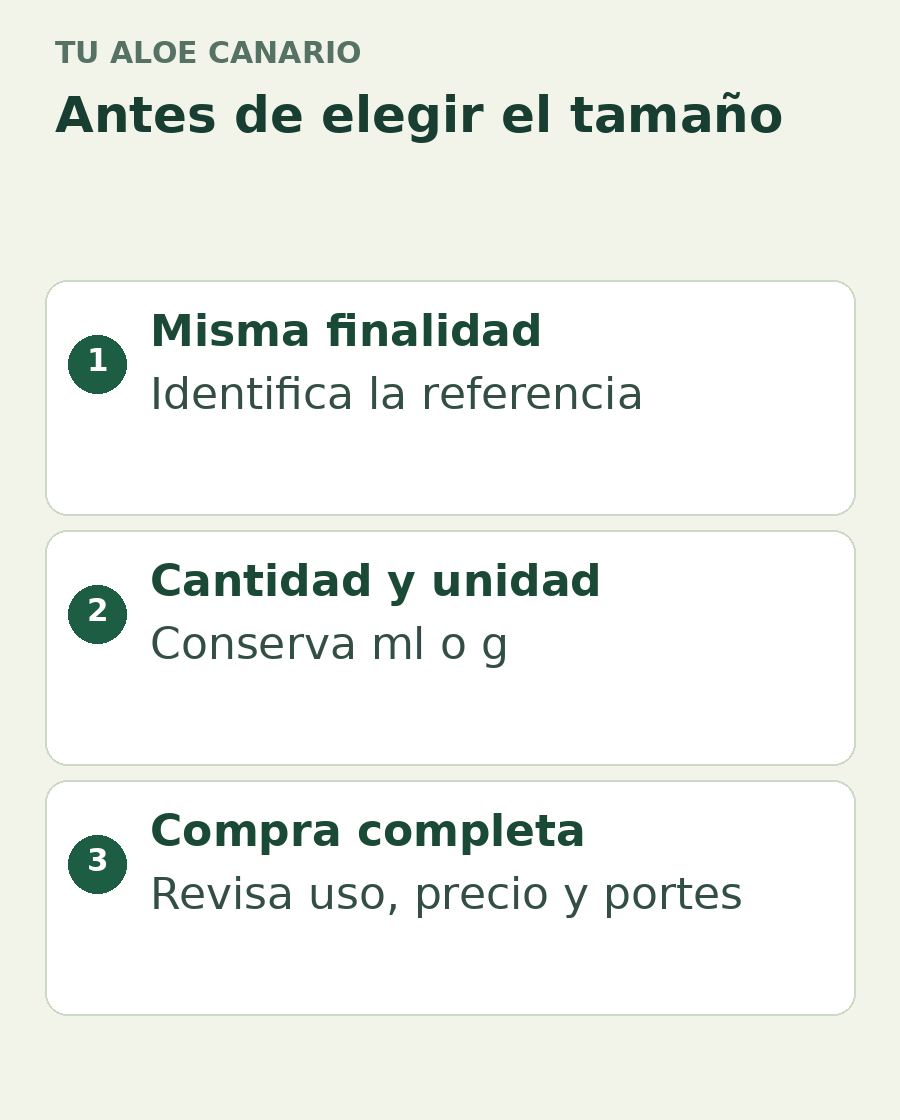
Start with a pair that meets the same need. Comparing two sizes of the same product is more direct than setting a soap against a serum. An aloe vera gel and a cream may have different purposes, directions and formulas; a lower unit price doesn't prove greater effectiveness.
You can use our Aloe Care Privilege catalogue to identify products and sizes. Check each current product page rather than carrying over the size or price of one product to another with a similar name.
Grams and millilitres are not interchangeable
If a bar states grams and a cream states millilitres, keep those units. We can't know a cosmetic's density from its texture, so we shouldn't convert 100 g into 100 ml by guesswork. When comparing different products, group those that state weight separately from those that state volume.
The format you'll actually use matters too
The calculation above describes the price of the quantity bought, not your future use. Before choosing a large pack, think about where you'll keep it, who will use it and what period of use appears on its label. AEMPS explains that the minimum durability date and the period after opening are part of a cosmetic's information where applicable. [2]
You can note when you started your current pack and how much you usually use, without promising a fixed number of applications. That small record will help with your next purchase. There's no need to use more product just to finish it sooner.
Keep product, shipping and purchase terms separate
When buying online, keep two figures in mind: the unit price of the cosmetic and the final order total. Shipping depends on the destination and the conditions in force. A price per 100 ml doesn't automatically include delivery, and a promotion may have its own requirements.
Before paying, check the pack size, the final price and the costs shown in the basket. If there's a discount, make sure it applies to that product and is still valid. We don't set shipping rates or offers in this guide, because they should be checked at the time of purchase.
Your five-point comparison template
Make one row per product with its exact name, contents, unit, current price and result on the same base. Add a note on the area of use and the size that fits your routine. If the formulas are different, say so explicitly so the table isn't read as a comparison of cosmetic results.
Frequently asked questions
Is the large size always the best buy?
Its unit cost may be lower, the same or higher. Do the maths and consider how much you'll use according to the directions on the pack. The example in this guide sets no rule about our sizes.
Is a 50 ml pack lower quality than a 250 ml one?
Quantity alone doesn't determine quality or function. Identify the product and its formula before comparing two different products.
Can I use this formula for a soap sold in grams?
Yes, keeping the weight: price divided by grams and multiplied by 100 gives a price per 100 g. Don't mix that result with one expressed per 100 ml.
Learn more
See how to choose between aloe vera gel, cream and soap and work out the purpose of each format first. That way the price comparison supports a well-informed choice.
Sources
[1] BOE · Royal Decree 3423/2000 on price indication (in Spanish)
[2] AEMPS · Health guarantees and cosmetic labelling (in Spanish)
[3] Our Aloe Care Privilege catalogue
Sources consulted on 30 October 2026.

Comments (0)