
Shopping Cart
- Tu Aloe Canario
- Canarian Aloe Vera
- 0 likes
- 678 views
- 0 comments

Almost every home in the Canary Islands has an aloe plant tucked away somewhere. Many of us grew up with the same scene: someone got splashed by hot oil in the kitchen or came back from the beach with red shoulders, and a grandmother would cut a leaf, open it with a knife and spread that cold, clear gel without a word. She had never heard of acemannan and never read a study. She simply knew it worked.
More than twenty years after we started working with aloe, we still feel the same respect for this plant. But now we also know why it does what it does, and where the evidence ends and the legend begins. That is what this article is about: what we have learned, told slowly and without exaggeration.
A desert plant that found a home on the islands
The aloe vera grown in the Canary Islands is Aloe barbadensis Miller, the same species botanists call Aloe vera (L.) Burm.f. According to the Royal Botanic Gardens, Kew, it originates from the Arabian Peninsula and travelled the world from hand to hand (Kew record). It is a succulent: it stores water in its thick leaves to survive drought, and that is exactly what makes it so valuable.
On the islands it found a climate that suits it perfectly: mild temperatures all year, almost no frost, plenty of sunshine, cooling trade winds and well-drained volcanic soils. A plant needs three to four years before it produces mature leaves with the densest gel.
What is inside an aloe leaf
- The green rind. The skin of the leaf. It protects the plant and is not used in good cosmetics.
- The yellow latex. Just under the rind runs a bitter yellow sap rich in anthraquinones such as aloin, a strong laxative. This is what must be carefully removed.
- The inner gel. The clear heart of the leaf. This is what we are after.
The gel is 98.5 to 99.5 % water. The remaining one per cent contains more than seventy identified substances: polysaccharides, amino acids, minerals such as magnesium and zinc, vitamins, enzymes, plant sterols, saponins and a little salicylic acid. The star is acemannan, a long-chain polysaccharide that holds water and leaves a light film on the skin. It is also fragile: heat, time and poor storage break it down, which is why leaves are processed within hours of being cut.
What science has actually measured
Skin hydration
In 2006 a team at the University of São Paulo applied creams with freeze-dried aloe vera extract to the forearms of twenty women and measured skin moisture with a corneometer. After two weeks of daily use, every formula containing aloe increased hydration compared with the same cream without it, even at just 0.1 % (Dal'Belo et al., Skin Research and Technology, 2006).
After the sun
Aloe vera has been studied for decades in skin care, including in clinical settings. But a burn, especially if it blisters or covers a large area, is a matter for a doctor. For warm, tight skin after a day at the beach, aloe gel is a simple, pleasant ritual: cool to apply and easy to use.
Where the evidence falls short
A 2012 Cochrane review found insufficient evidence to recommend aloe for chronic wounds such as ulcers (Dat et al., 2012). The US National Center for Complementary and Integrative Health considers topical aloe gel generally well tolerated, while oral latex can cause serious digestive problems (NCCIH). In 2016 the IARC classified non-decolourised whole-leaf extract as possibly carcinogenic because of aloin, and since 2021 the EU has banned aloe preparations containing hydroxyanthracene derivatives in food. In short: the quality of processing matters enormously.

How to use Canarian aloe vera every day
After the sun: lukewarm shower, pat dry and apply a generous layer of gel. Keep it in the fridge for extra relief. Our pure Canarian aloe vera gel 250 ml is the one visitors take home every summer.
On your face: a thin layer of gel in the morning before moisturiser and sunscreen leaves skin fresh without shine.
On your body: after a shower, on slightly damp skin, a cream with aloe and chamomile such as our aloe vera and chamomile cream 250 ml makes a difference within days.

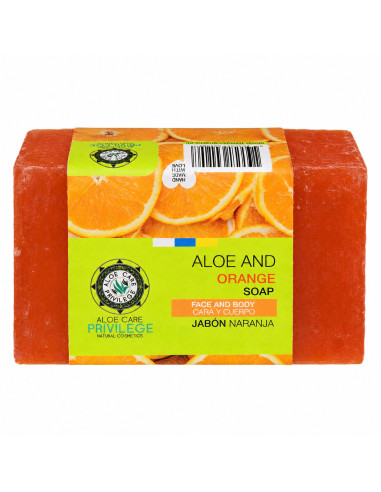
In the shower: a bar soap with aloe cleanses without tightness and lasts for weeks. Try our soaps with Canarian aloe vera, from honey and propolis to orange, lavender or rosemary.
How to choose a good aloe vera product
- Find aloe in the ingredient list. It appears as Aloe Barbadensis Leaf Juice or Leaf Extract. The higher up, the more there is.
- Check the percentage. A pure gel should be around 99 % aloe.
- Ask about origin. Where it was grown and processed tells you a lot.
- Beware of miracles. A cosmetic does not cure disease.
Frequently asked questions
Is Canarian aloe vera better than aloe from elsewhere?
The species is the same. What changes is how the plant grows and how quickly the leaf is processed after cutting. The island climate and the short distance from field to lab both help.
Can I use aloe vera on my face every day?
Yes, most skin types tolerate it well. If it is your first time, patch test on a small area first.
Can I drink cosmetic aloe gel?
No. Cosmetic gels are made for the skin only.
Do you ship to my country?
We ship from Tenerife to the Canary Islands, mainland Spain and Europe. Shipping is free from €50 in the Canaries, from €100 in mainland Spain and from €200 in the rest of Europe.
From Tenerife, with our hands in the soil
We have worked with Canarian aloe vera for more than twenty years. If you are not sure which product suits you, write to us and a real person will answer. And if you would like to browse, here is the full Aloe Care Privilege range.
This article is for general information and does not replace advice from a healthcare professional. The products mentioned are cosmetics. Sources: Kew POWO; Dal'Belo et al. 2006; Dat et al., Cochrane 2012; NCCIH; IARC Monograph 108 (2016); Regulation (EU) 2021/468.

Comments (0)