
Shopping Cart
- Canarian Aloe Vera
- 0 likes
- 297 views
- 0 comments
Every week someone messages us on WhatsApp or drops by our office in Puerto de la Cruz with a bottle of aloe in hand and the same question: "I bought this as Canarian aloe – is it really?" Often the answer is no. And it's not the customer's fault: aloe vera labelling is a bit of a maze, and some people take advantage of that.
We've been working with aloe vera from Tenerife and Fuerteventura for over 20 years, and for almost 15 with our own brand, Aloe Care Privilege. In this article we share, without jargon, everything we've learned so you never get fooled again.
The problem: lots of "Canary Islands" on the label, little Canarian aloe inside
Aloe vera from the Canary Islands is famous worldwide, and fame attracts imitations. According to an inspection by the Government of the Canary Islands reported in the press, around 64% of the products inspected used the words "Canarias" or "Canary Islands" without having been produced in the archipelago. The regional government itself has estimated that the fraud of aloe sold as Canarian is worth around €21 million.
The issue is so serious that the University of La Laguna and the ITER institute launched a study to certify the origin of Canarian aloe using the plant's natural chemical "fingerprints", such as strontium isotopes from the volcanic soil. In other words, aloe from here literally carries the signature of our land.
Why is aloe vera from the Canary Islands so highly valued?
Aloe barbadensis Miller, true aloe vera, finds conditions on the islands that are hard to match:
- Sunshine all year round and mild temperatures, without frost.
- Mineral-rich volcanic soils.
- Trade winds that ventilate the plantations naturally.
- Tradition: the plant has been known in the Canaries for centuries as "sábila" or "zábila".
Lanzarote, Fuerteventura, Gran Canaria and Tenerife have the main plantations. We work with certified organic aloe from Tenerife and Fuerteventura.
How to recognise genuine Canarian aloe vera in 5 steps
1. Look for where it's made, not just the word "Canarias"
A drawing of a volcano, the word "Canary" in big letters or a dragon tree on the label guarantees nothing. What matters is who makes it and where. Check the manufacturer's or responsible person's address in the small print: if it's in the Canary Islands and the company explains where its aloe comes from, you're on the right track.
2. Read the first ingredient
Cosmetic ingredients are listed from the largest amount to the smallest. In a good aloe product, the first should be Aloe Barbadensis Leaf Juice. If the first is Aqua (water) and aloe appears fifth or sixth, the product contains little aloe even if the label says "aloe vera" in big letters.
In our aloe formulas, Canarian aloe vera is always the first active ingredient.
3. Be wary of aloe powder and inflated "% aloe" claims
Much of the aloe used worldwide arrives dehydrated as powder from other continents and is reconstituted with water. If you see Aloe Barbadensis Leaf Extract or Powder, ask. And watch out for percentages: some manufacturers calculate "100% aloe" on the reconstituted powder, not on the final product.
4. Bright green is a warning sign
Natural aloe vera gel is clear or slightly yellowish, never neon green. A very green gel almost always contains colouring. Our pure Canarian aloe vera gel contains no colourings.
5. Ask about the plant's age and organic certification
An aloe plant needs time to mature. We only use plants over 3 to 4 years old, when the leaf has reached maturity. And always ask for organic certification: it guarantees the aloe was grown without synthetic pesticides.
Quick table: Canarian aloe vs imported aloe
| What to check | Genuine Canarian aloe | Warning sign |
|---|---|---|
| Manufacturer | Company based in the Canaries that explains its origin | Only says "Canary" or has island drawings |
| First ingredient | Aloe Barbadensis Leaf Juice | Aqua, with aloe at the end of the list |
| Form of aloe | Fresh leaf juice | Extract or reconstituted powder |
| Gel colour | Clear or slightly yellowish | Bright green |
| Cultivation | Certified organic, mature plants | No information |
Common myths about aloe vera
"All aloe is the same." No. There are more than 400 aloe species and only one is Aloe barbadensis Miller, true aloe vera. And even within it, cultivation, plant age and processing make a big difference.
"The greener, the more natural." Quite the opposite, as we've seen.
"Aloe vera is native to the Canary Islands." Not exactly. It has been grown here for centuries and is perfectly adapted, but its origin lies in the Arabian Peninsula (Kew places its native range in northern Oman). We explain this in detail in another blog article.
What we do so you know what you're buying
- We only work with certified organic aloe vera from Tenerife and Fuerteventura.
- We use plants over 3 to 4 years old.
- Canarian aloe is the first active ingredient in our aloe formulas.
- And if you have any questions about a product, message us on WhatsApp: you'll get an answer from us, the same team behind the products.
Where to start?
If it's your first time with Canarian aloe vera, these are the three products we recommend most:
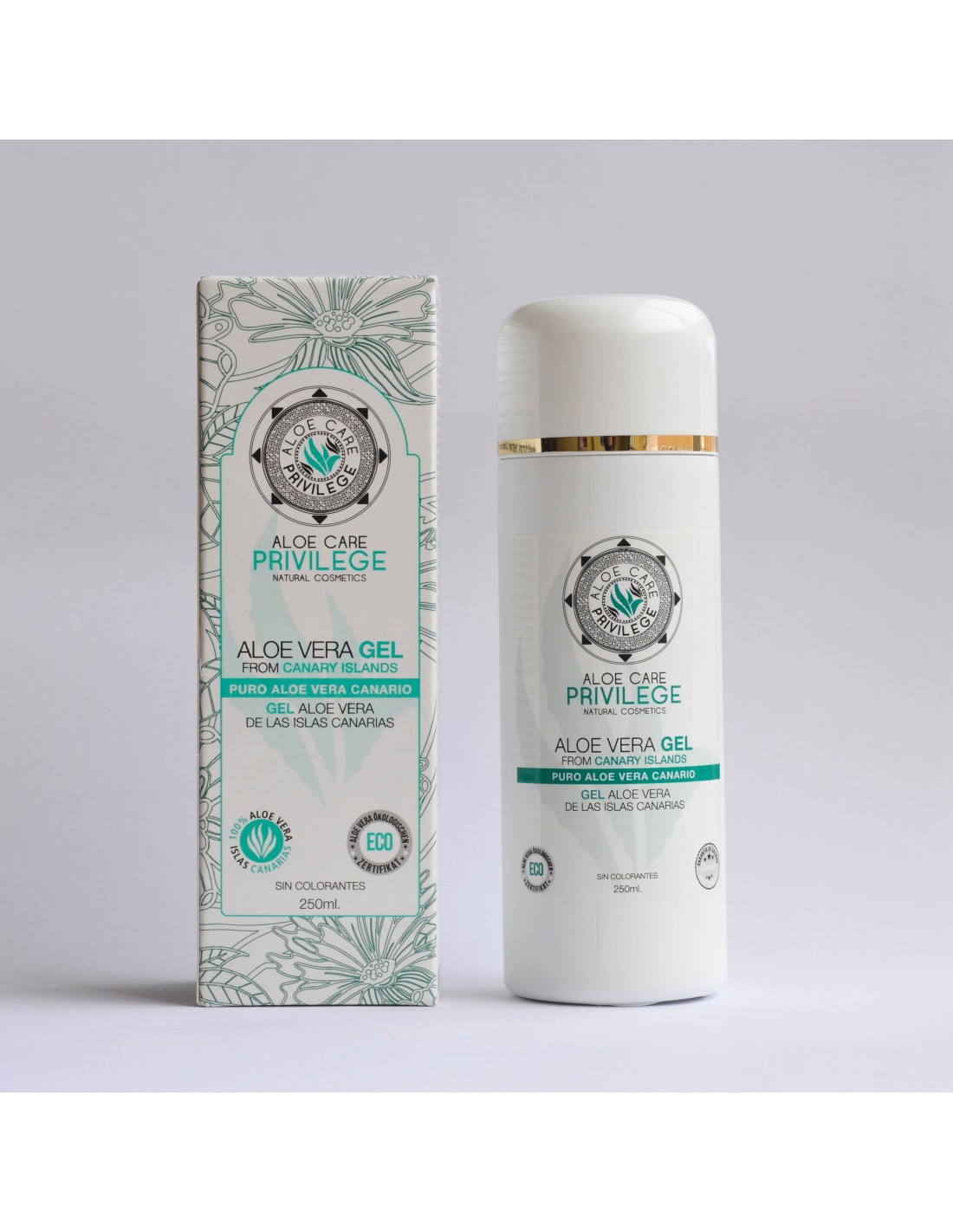
- Pure Canarian aloe vera gel, 250 ml: the most versatile – after sun, after shaving or as light everyday care.
- Canarian aloe vera and chamomile cream: our daily moisturiser for face and body.
- Hot-cold gel with arnica and devil's claw: for massage after sport.
Frequently asked questions
How do I know if aloe vera is from the Canary Islands?
Check the manufacturer's address, that the first ingredient is aloe leaf juice and that the brand explains which island its aloe comes from.
Which island has the best aloe vera?
Lanzarote, Fuerteventura, Gran Canaria and Tenerife all have excellent conditions. More than the island, what matters is organic cultivation, the age of the plant and how it's processed.
Is Canarian aloe vera more expensive?
Usually, because growing aloe here costs more: cultivation, labour and transport to the islands. So be wary of prices that seem too low.
Do you ship outside the Canary Islands?
Yes – to mainland Spain (free on orders over €100) and to the rest of Europe (free on orders over €200).
Written by the Tu Aloe Canario – Aloe Care Privilege team, in Tenerife.
Sources: University of La Laguna (ULL-ITER study on the origin of Canarian aloe, 2023); Government of the Canary Islands data published by elDiario.es / Canarias Ahora.
Comments (0)