
Shopping Cart
- Tu Aloe Canario
- Canarian Aloe Vera
- 0 likes
- 314 views
- 0 comments
If you're looking for an aloe cream, it's natural to look for that word first. But moisture also invites you to look at the other ingredients in the formula. Today we focus on one of those names that often go unnoticed: Glycerin.
We want to explain what it can do and how to read its presence without asking a single word to explain the whole product. Next time you look at an aloe vera cosmetic, you'll have a more useful question to ask.

Editorial illustration about reading ingredients. The pack and scene are generic.
A small name with a specific job
Glycerin, also called glycerol, is used as a humectant. Put simply, it helps hold on to moisture. The COSMILE Europe ingredient profile lists this function and its use in creams and lotions, among other cosmetics.
So finding glycerin in an aloe cream isn't a contradiction. The name of the star ingredient doesn't mean the rest of the formula disappears. We think it's worth understanding what each component is for before judging the whole.
Origin can't be guessed from the name either
The COSMILE profile allows for plant or synthetic origin for glycerin. Reading Glycerin doesn't tell you which raw material the one in a specific pack comes from. If that origin matters to your purchase, ask for information about the product and its supplier rather than guessing from the look of the jar.
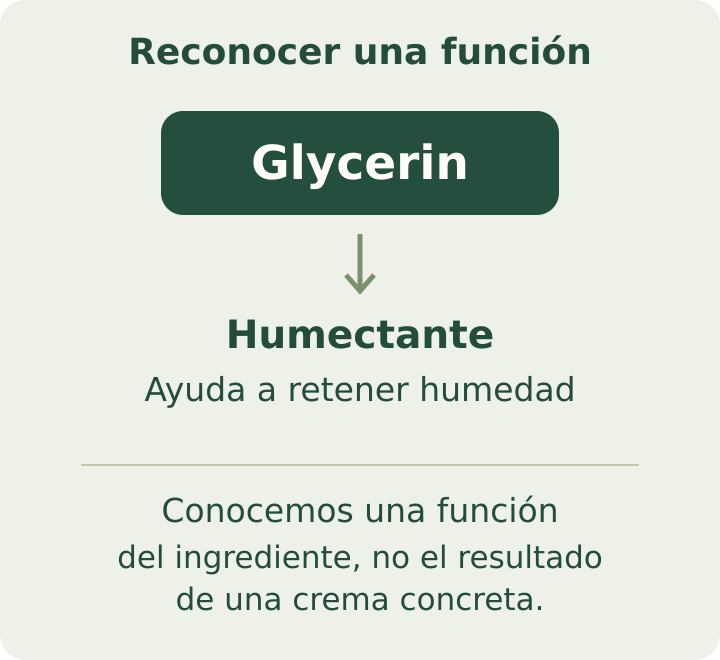
Diagram of the humectant function; it is not a measurement of our products.
A hydration test tells you something specific
Knowing an ingredient's function and testing a finished cream are different steps. A 2001 study by Lodén and Wessman compared a cream with 20% glycerin and its placebo in 17 healthy people. It was a bilateral, double-blind trial.
According to the abstract, after ten days hydration measured with a corneometer increased, but no effect was seen on water loss through the skin or on the irritation response assessed. It describes that formulation – not our cosmetics, and not a concentration for home-made preparations.
Our practical takeaway: when a claim talks about hydration, it's worth knowing what was measured. An improvement in one measurement doesn't automatically prove all the others. And a different cream that also contains glycerin isn't the formula that was studied.
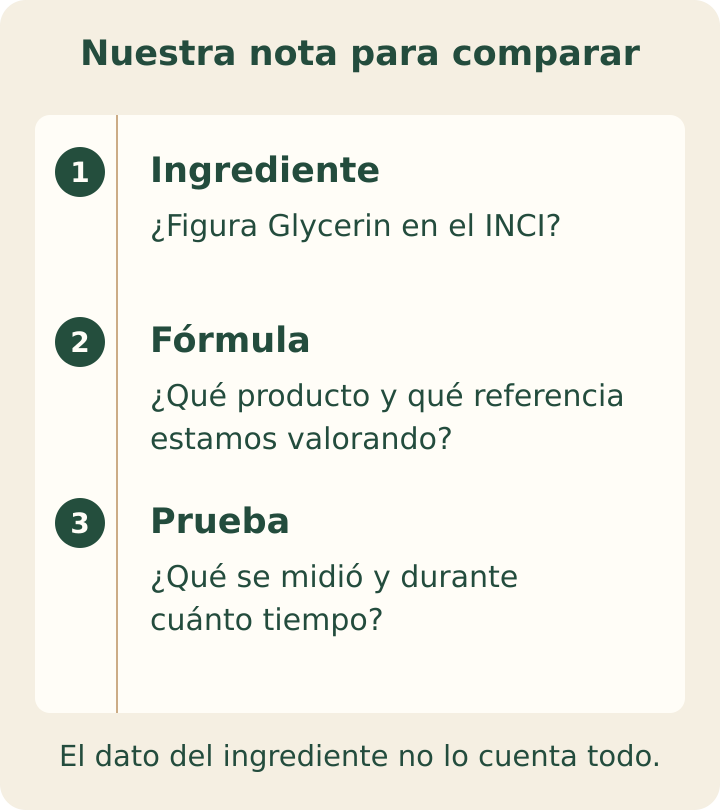
Visual guide to separating ingredient, product and test. It is not a commercial label.
Taking this into an everyday purchase
You don't need to read a scientific paper every time you choose a cream. Start by finding the ingredient list and the directions on the pack. AEMPS points out that labelling must let you identify the product, its function and its composition.
Then separate what you know from what you still need. Finding Glycerin lets you recognise that ingredient; on its own it doesn't give the exact percentage, its origin or how many hours the cosmetic moisturises. To compare two products, use the full label and the information supporting their claims.
We apply the same approach to our products: we talk about the specific product. A general explanation of glycerin doesn't replace its INCI list, nor does it allow us to add ingredients to a product page because they're common in other creams.
Choose the formula as it comes
Understanding an ingredient is not an invitation to add it to the jar. AEMPS advises against adding substances to a cosmetic or mixing products not intended for it by the manufacturer. Adding glycerin, water or aloe pulp would change the product you're using.
Our suggestion is simpler: choose a formula whose use suits you, follow its instructions and ask your questions with the pack in front of you. That way aloe keeps its appeal without the rest of the composition becoming a list we skip over.
Learn more
In our guide to Canarian aloe vera from leaf to cosmetic we explain the ingredient's journey. To understand another function in a formula, continue with preservatives in aloe cosmetics. To ask about a specific product, write to us here.
Sources for further learning
Lodén and Wessman · International Journal of Cosmetic Science, 2001
Primary research on a glycerin cream and its placebo. Authors' abstract consulted; the full text is not presented as read.
AEMPS · Health guarantees and labelling (in Spanish)
Information on composition, use and substantiation of cosmetic claims.
AEMPS · Good practice in using cosmetic products (in Spanish)
Use according to the label, and advice not to add substances or make unintended mixtures.
COSMILE Europe · Glycerin profile
Cosmetics Europe ingredient database: identity, functions and possible origins. An industry technical reference, not an approval of our products.
Tu Aloe Canario · Aloe Care Privilege
Sources reviewed on 4 November 2026.

Comments (0)