
Shopping Cart
- Tu Aloe Canario
- Canarian Aloe Vera
- 0 likes
- 147 views
- 0 comments
You turn the jar over and find a date, a little open jar symbol and a code that seems to mean nothing. It's easy to glance at them and carry on with your routine. We prefer to read them as three different clues: one is about durability, one about the time after opening and one identifies the batch.
You don't need to turn your bathroom into a lab. Just locating each detail and remembering when you opened the product gives you a much clearer way to organise your aloe vera cosmetics.
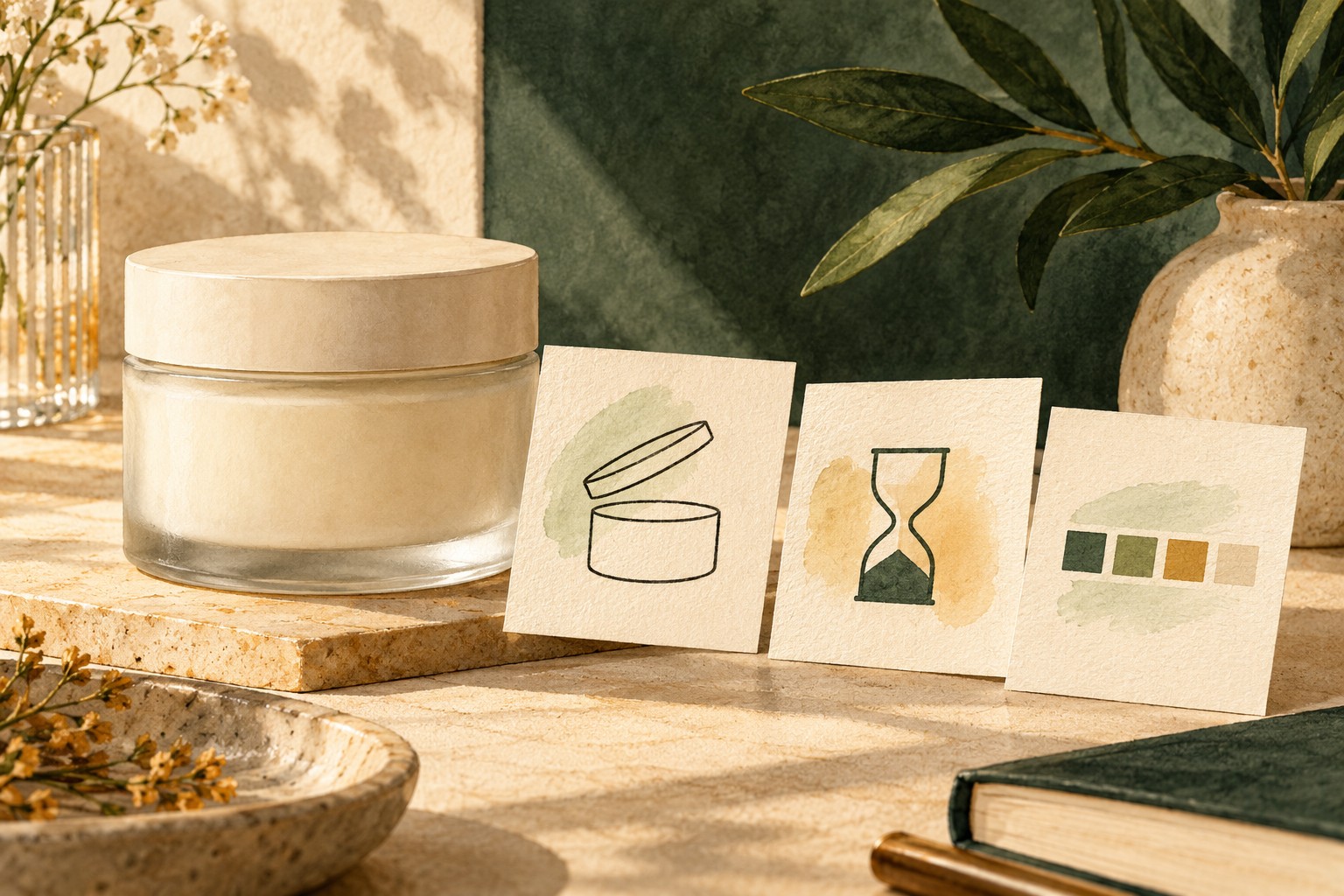
Editorial illustration with a generic jar and schematic labelling symbols. It does not reproduce the label of one of our products.
The date and the open jar tell you different things
The minimum durability date refers to the time during which the cosmetic keeps its safety and properties if stored properly. The period after opening, known as PAO, shows how long it can be used once opened. It's usually shown as an open jar with a duration.
Under EU labelling rules, minimum durability and PAO are used according to the product's characteristics and shelf life. So we shouldn't expect every pack to carry exactly the same symbols. Nor will we assign a generic period to all aloe creams: you need to read the specific product.
If you see, for example, a jar with "6M", that's an example of six months after opening, as long as the stated conditions are respected. That number doesn't mean the product can be kept unopened indefinitely. If the pack gives more than one time indication, opening it doesn't extend a date already printed on it.
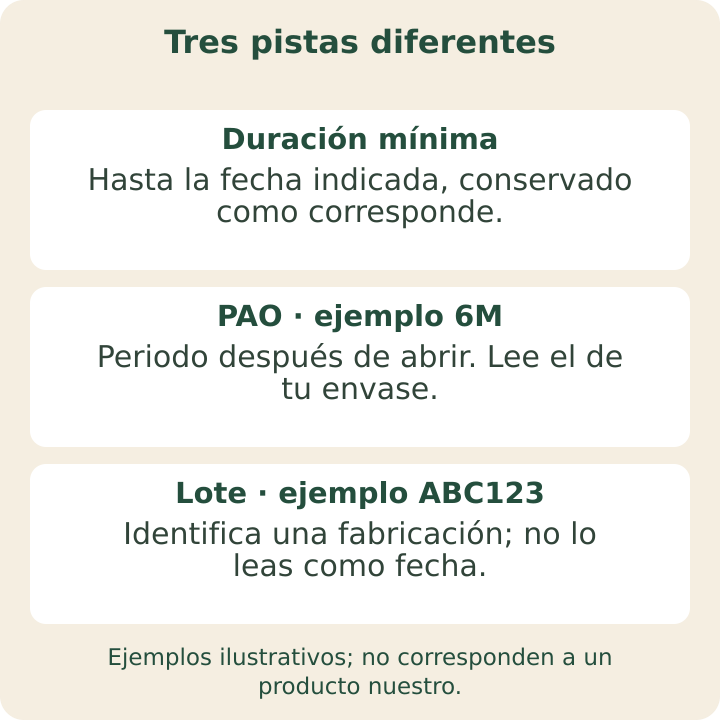
Editorial diagram: three different clues.
That little code is worth keeping too
The batch number identifies the product. It may combine letters and numbers, but we shouldn't read it as a date unless the manufacturer explains their system. A code that looks like a date may still be just a code.
It's worth keeping because it makes a query precise. Saying "I have this cream" tells us less than giving the product, size, batch and opening date. A clear photo of the back of the pack is usually the easiest way to keep those details together.
Two situations that are easier to understand with the pack in front of you
Imagine two jars of the same size. One was opened recently and its instructions are still legible; for the other, you can't remember when you opened it and you've lost the box with some of the information. The answer isn't to decide by which looks fuller. Recover the details of the second one and ask the responsible company if you can't identify its period of use.
Another example: you find a cosmetic that has spent time in a car in the sun. Even if the printed period hasn't run out, storage conditions matter too. The calendar doesn't replace the label or turn unsuitable storage into proper storage.
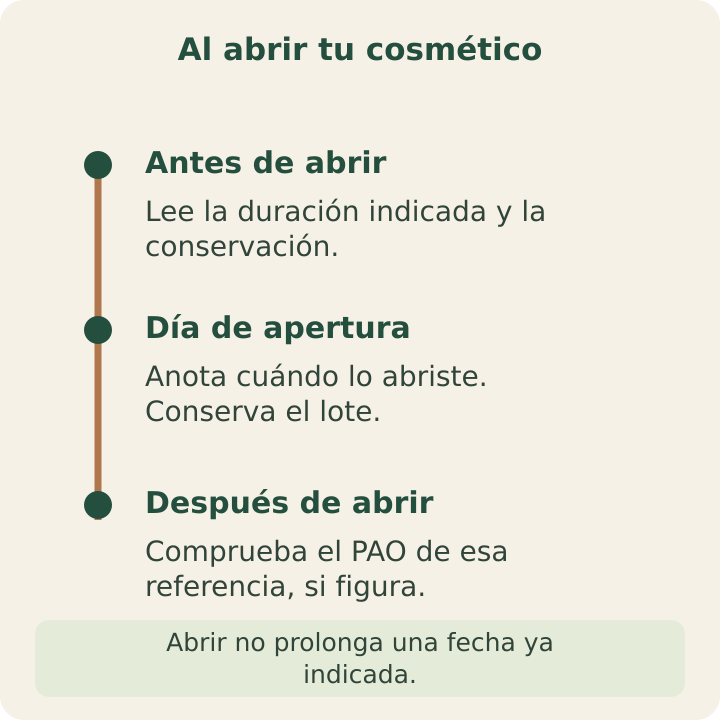
Editorial diagram: when you open your cosmetic.
A small habit that makes life easier
When you open a product, note the date somewhere that doesn't cover the batch or instructions. Keep the box if it has information not shown in full on the container. Then store the cosmetic as the label says and close it after use.
If you notice an unexpected change in smell, texture or appearance, stop using it and get in touch with its details to hand. And remember the limit of that check: a product looking normal doesn't by itself prove it's still within its period of use.
Does the same PAO apply to all aloe products?
No. It depends on the specific product. Sharing a plant ingredient doesn't make two formulas, or their conditions of use, the same.
Can we tell you how long a pack lasts without seeing its label?
We'd rather ask for the product name and a clear photo. That way we can talk about the product you actually have and avoid giving it a period that belongs to another.
Learn more
In our guide to preservatives in aloe cosmetics we explain another side of preservation. To ask about a specific pack, write to us.
Sources for further learning
AEMPS · Cosmetic labelling and symbols (in Spanish)
AEMPS · Good practice in using cosmetic products (in Spanish)
Tu Aloe Canario · Aloe Care Privilege

Comments (0)